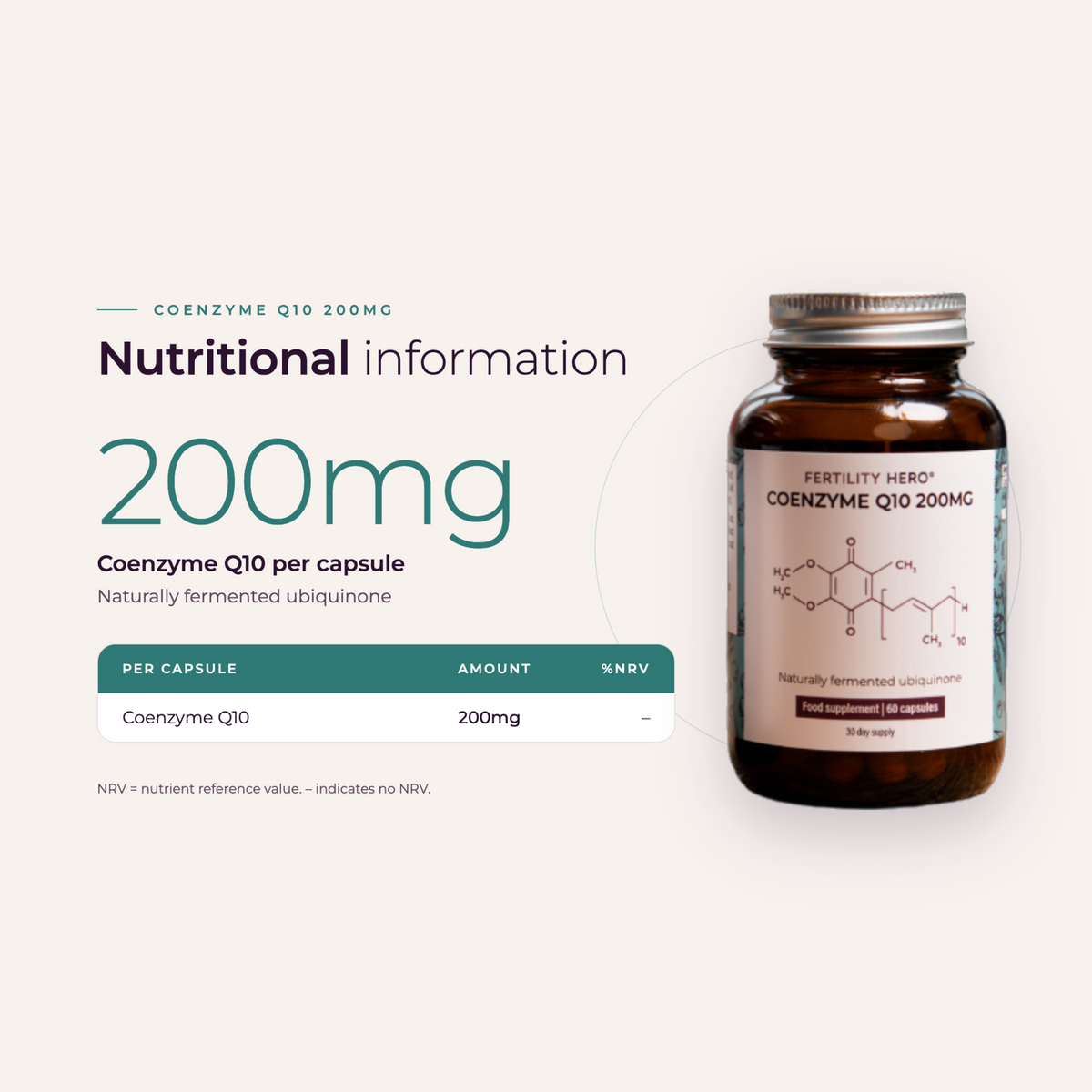
Coenzyme Q10 200mg
Coenzyme Q10 200mg
Naturally-fermented ubiquinone | 400mg daily dose
High-dose naturally-fermented CoQ10, for men who want to do everything they can in the three months that matter.
- 400mg per day: one 200mg capsule taken twice daily
- Naturally-fermented ubiquinone: high purity and highly stable
- Ubiquinone is the form most studied in fertility research
- In a glass bottle with no synthetic fillers, binders or additives
- Made in the UK to GMP standards
Learn why we use ubiquinone and not ubiquinol →
Our CoQ10 400mg provides 800mg per day and is the option we recommend for women over 35 or preparing for IVF or egg freezing. Made in the UK to GMP standards.
 60 day money-back guarantee on your first order.

- Inspired by our fertility journey
- Made in the UK to GMP standards
- Free UK shipping over £45
Couldn't load pickup availability
What is it?
What is it?
A high-strength, naturally fermented CoQ10 supplement providing 200mg ubiquinone per capsule. Take one capsule twice daily for a total daily dose of 400mg.
Ubiquinone is the form of CoQ10 widely used in fertility research.
60 capsules = 30 day supply.
Who is it for?
Who is it for?
For men who want to include CoQ10 as part of their preconception preparation, including those preparing for IVF or ICSI.
Ideally, start around three months before trying to conceive or fertility treatment.
Suitable for vegetarian and vegan diets. Free from allergenic ingredients.
How should I take it?
How should I take it?
Take one 200mg capsule twice daily, preferably with food — for example, one with breakfast and one with dinner.
CoQ10 is fat-soluble, so we recommend taking it with a meal containing some fat.
It can be taken alongside Fundamental Man, omega-3 and magnesium bisglycinate. If you take other supplements containing CoQ10, check the combined daily amount.
Most men start around three months before trying to conceive or before fertility treatment.
What's inside?
What's inside?
Naturally fermented ubiquinone — 200mg
Produced by fermentation and provided in the all-trans form.
Vegetable capsule shell (hydroxypropyl methylcellulose)
Plant-based.
Brown rice flour
Used to achieve the required capsule fill.
Bamboo silica
A plant-derived ingredient used to support consistent capsule filling.
How is it different?
How is it different?
Naturally fermented ubiquinone: produced by fermentation in the all-trans form, the same structural configuration found naturally in the body.
A high-strength daily dose: 200mg per capsule, taken twice daily to provide 400mg per day.
Ubiquinone: the form of CoQ10 widely used in male fertility research.
Simple formulation: CoQ10 with only the ingredients needed to make the capsule.
Amber glass bottle: helps protect the contents from light and reduces the product’s contact with plastic.
Made in the UK: manufactured to Good Manufacturing Practice (GMP) standards.


Allergen information
This product is free from all 14 major allergens as defined by UK food supplement labelling regulations — including gluten and soya.
Who is this for?

“During our IVF journey, so much of the focus was on what I should be doing. But my husband was preparing too, and we became much more conscious of the role male preconception preparation could play.
CoQ10 was one of the supplements we came across again and again in the research. I wanted to make choosing it simpler: naturally fermented ubiquinone, at a meaningful dose, without unnecessary extras.”
Why CoQ10 is so interesting in male fertility research
CoQ10 has an established biological role in mitochondrial energy production and antioxidant activity, and has been widely studied in male reproductive research. Here’s the science behind it — and why we chose naturally fermented ubiquinone.
CoQ10 is naturally present in mitochondria, where it plays an essential role in the process used to produce ATP — the cell’s energy currency. Sperm contain mitochondria concentrated in the midpiece, and energy production is an important part of sperm function. This is one reason CoQ10 has attracted considerable interest in male reproductive research.
CoQ10 acts as an electron carrier within the mitochondrial electron transport chain, transferring electrons between complexes I/II and complex III as part of oxidative phosphorylation and ATP production.
Researchers have investigated CoQ10 in relation to male reproductive health, including sperm motility and other semen parameters. Human clinical studies have also investigated CoQ10 supplementation in men, although research findings should not be interpreted as a guarantee that supplementation will improve sperm parameters or fertility outcomes.
† No Nutrient Reference Value (NRV) has been established for CoQ10.
CoQ10 has two closely connected biological roles. Alongside its involvement in mitochondrial energy production, its reduced form, ubiquinol, can act as a lipid-soluble antioxidant. Oxidative stress is an important area of research in male reproductive health, including research into sperm function and DNA fragmentation.
CoQ10 cycles between its oxidised form, ubiquinone, and reduced form, ubiquinol. Ubiquinone participates in mitochondrial electron transport, while ubiquinol can act as an antioxidant within lipid membranes.
Sperm membranes contain high concentrations of polyunsaturated fatty acids and are particularly susceptible to oxidative stress. Researchers have studied relationships between oxidative stress, sperm motility, semen parameters and sperm DNA fragmentation, as well as the potential role of antioxidants including CoQ10. CoQ10 supplementation has therefore been investigated in a number of clinical studies in men.
† No Nutrient Reference Value (NRV) has been established for CoQ10.
We use naturally fermented ubiquinone in the all-trans form — the same structural configuration found naturally in the body. Ubiquinone is also the form of CoQ10 used in clinical studies investigating supplementation in male reproductive health.
CoQ10 can be produced through different manufacturing methods. Fermentation can be used to produce all-trans ubiquinone, matching the configuration of naturally occurring CoQ10.
We chose ubiquinone deliberately. This form has been used in human male fertility research, including clinical trials investigating CoQ10 supplementation and semen parameters. Fundamental CoQ10 provides 200mg per capsule and 400mg across the recommended daily serving.
† No Nutrient Reference Value (NRV) has been established for CoQ10.