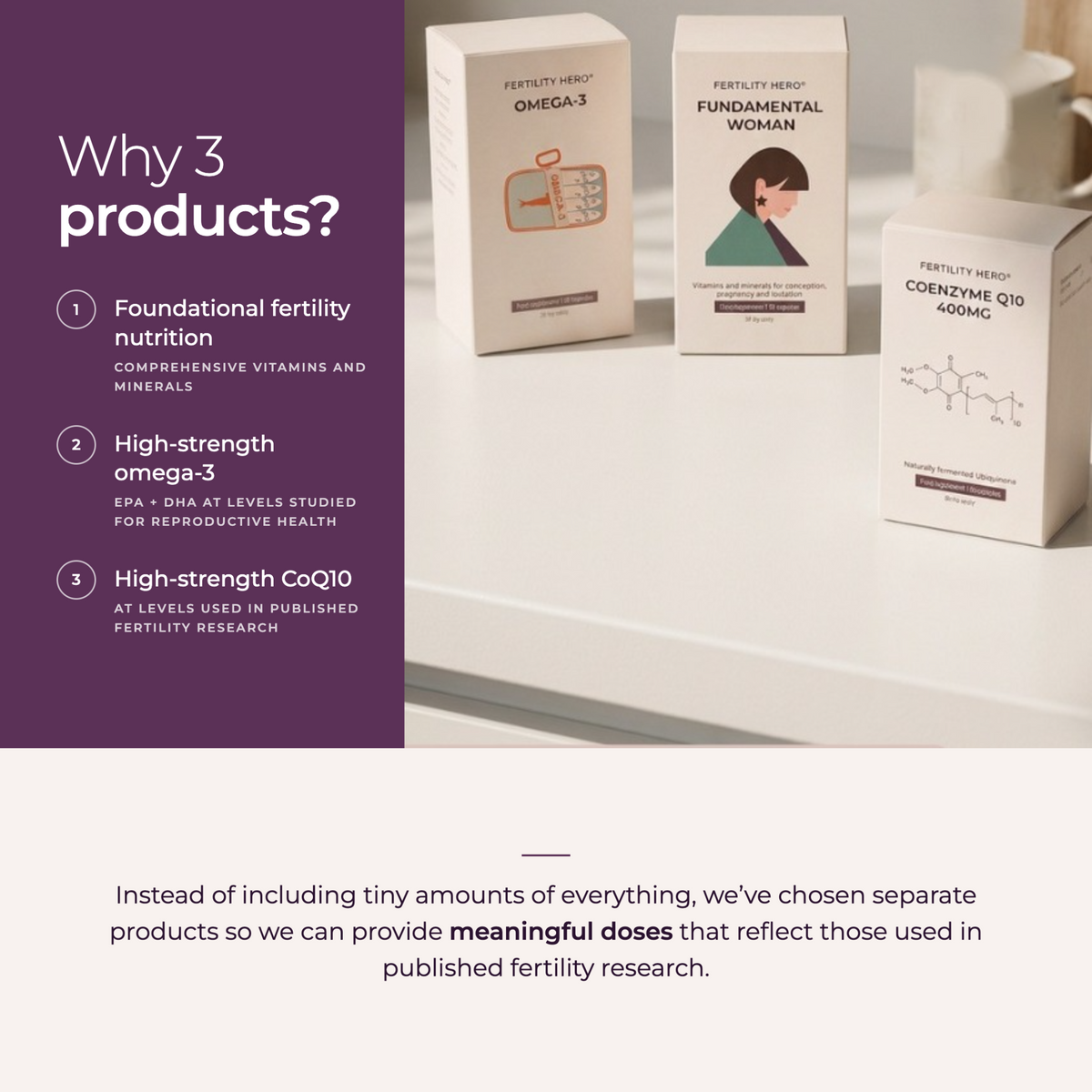
“After years of trying to conceive and going through IVF, I became incredibly conscious of what I was putting into my body. That only intensified when I finally became pregnant — I wanted to understand not just what I was taking, but why it was there and whether the amount was meaningful.Read our full story →
With our omega-3, I wanted meaningful amounts of both EPA and DHA, in one product that could support the nutritional needs of the journey from trying to conceive through pregnancy and breastfeeding.”
Fundamental Omega-3 | High-strength EPA & DHA
Fundamental Omega-3 | High-strength EPA & DHA
High-strength omega-3 for men & women
Fertility, pregnancy & breastfeeding support
- 1,100mg EPA + DHA per daily dose
- 440mg DHA — maternal DHA intake contributes to normal brain and eye development of the foetus and breastfed infant*
- Anchovy-sourced — small fish, low on the food chain
- From preconception through pregnancy and breastfeeding
*The beneficial effect is obtained with a daily intake of 200mg DHA in addition to the recommended daily intake of 250mg EPA and DHA for adults.
Regular price
£24.00 GBP
Regular price
Sale price
£24.00 GBP
Taxes included.
Shipping calculated at checkout.
 60 day money-back guarantee on your first order.
- Inspired by our fertility journey
- Made to GMP standards
- Free UK shipping over £45
Quantity
Couldn't load pickup availability
What is it?
What is it?
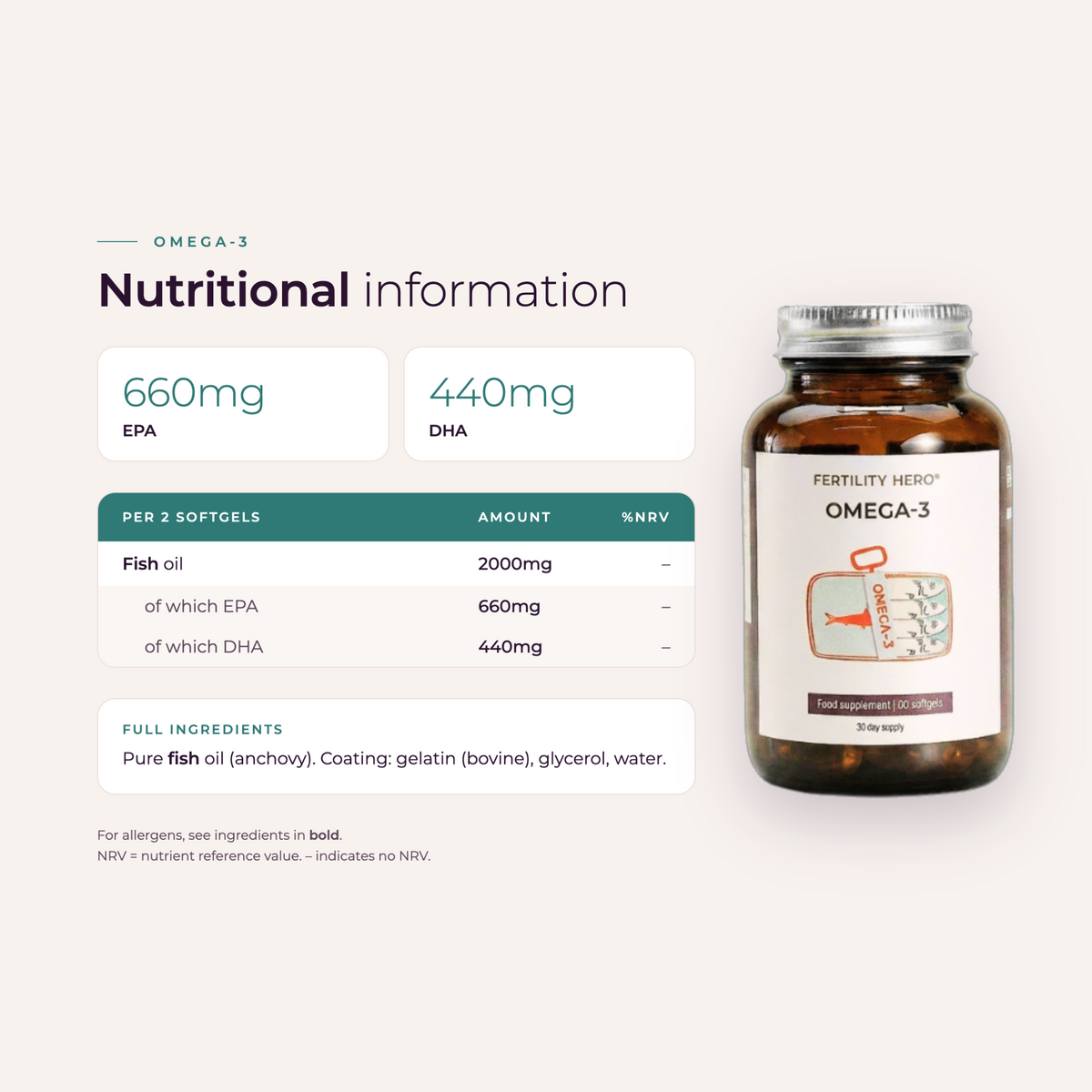
A high-strength omega-3 supplement providing 1,100mg EPA + DHA per daily serving, including 660mg EPA and 440mg DHA.
Designed for both men and women during preconception, and for women to continue throughout pregnancy and breastfeeding.
60 softgels = 30 day supply.
Who is it for?
Who is it for?
For men and women preparing to conceive, including couples preparing for IVF or other fertility treatment.
It’s also designed for women to continue taking throughout pregnancy and breastfeeding, providing 440mg DHA per daily serving.
Made with Halal-compliant bovine gelatine. Contains fish.
How should I take it?
How should I take it?
Take two softgels daily, preferably with food.
You can take both together or split them across two meals — whichever makes them easiest to remember.
Omega-3 can be taken alongside Fundamental Woman or Fundamental Man, CoQ10, myo-inositol and magnesium bisglycinate. If you take other omega-3 supplements, check the combined daily amount.
What's inside?
What's inside?
EPA (Eicosapentaenoic acid) 660mg per daily dose
DHA (Docosahexaenoic acid) 440mg per daily dose
Total omega-3: 1,100mg per daily dose
Pure fish oil from anchovy (ethyl ester form)
Coating: gelatin (bovine), glycerol, water.
ALLERGY INFORMATION: CONTAINS FISH
How is it different?
How is it different?
For men and women: one omega-3 designed to fit into both partners’ preconception routines.
1,100mg EPA + DHA: 660mg EPA and 440mg DHA across the recommended daily serving.
Continue through pregnancy and breastfeeding: 440mg DHA per day, with DHA contributing to normal brain and eye development of the foetus and breastfed infant.*
EPA + DHA together: rather than focusing on DHA alone, our formula provides meaningful amounts of both long-chain omega-3 fatty acids.
One product across the journey: designed so women don't need to change omega-3 when moving from preconception into pregnancy and breastfeeding.
*The beneficial effect is obtained with a daily intake of 200mg DHA in addition to the recommended daily intake of 250mg EPA and DHA for adults.


Allergen information
This product contains fish.
It is free from the remaining 13 major allergens as defined by UK food supplement labelling regulations, including gluten and soya.
1,100mg
Combined EPA and DHA in every daily dose
4 stages
Preconception, IVF, pregnancy & breastfeeding
2 softgels
Daily serving, easy to swallow, no overpowering taste

“During our fertility journey, my husband and I were both taking omega-3, but when I became pregnant I started looking at it differently. I wanted to know I was getting meaningful amounts of DHA and EPA, and that I could feel confident continuing the same product through pregnancy and breastfeeding.
I wanted ours to be an omega-3 we could both take while trying to conceive — and that I wouldn’t need to rethink the moment I saw a positive pregnancy test.”
EPA + DHA across the fertility journey
Fundamental Omega-3 provides 1,100mg of EPA + DHA per daily serving. From preconception research to the established role of DHA during pregnancy and breastfeeding, explore why we include both long-chain omega-3 fatty acids.
Omega-3 & preconception research
⌄
Ingredient
Dose
Worth knowing
EPA + DHA
Long-chain omega-3 fatty acids
1,100mg
Studied in female reproductive health
Omega-3 fatty acids have attracted considerable interest in female reproductive research, including studies looking at dietary omega-3 intake, blood and follicular-fluid levels, and outcomes in women undergoing fertility treatment. We see omega-3 as part of the nutritional foundations of preconception rather than a treatment for infertility.
EPA and DHA are incorporated into cell membranes and are involved in the production of lipid signalling molecules. Researchers have investigated omega-3 status in relation to a range of reproductive processes and assisted-conception outcomes. The evidence is still developing, and associations seen in research should not be interpreted as a guarantee that supplementation will improve fertility or IVF outcomes.
EPA + DHA
Long-chain omega-3 fatty acids
1,100mg
Studied in male reproductive health
Omega-3 fatty acids are also an active area of male fertility research. DHA is an important structural fatty acid in sperm cell membranes, and researchers have investigated omega-3 status and supplementation in relation to semen parameters and male reproductive health.
Sperm membranes contain high concentrations of polyunsaturated fatty acids, including DHA. Research has examined relationships between omega-3 fatty acid status and semen parameters including sperm concentration, motility and morphology, as well as supplementation in men. This research is one reason omega-3 is of interest in male preconception nutrition, although supplementation should not be presented as a treatment for abnormal semen parameters or male infertility.
Why both EPA + DHA?
⌄
Ingredient
Dose
Worth knowing
EPA
Eicosapentaenoic acid
660mg
More than DHA alone
Pregnancy supplements often focus heavily on DHA, but we wanted an omega-3 that could sit across the whole fertility journey. Fundamental Omega-3 therefore provides a meaningful amount of EPA alongside DHA, rather than being a DHA-only formula.
EPA and DHA are distinct long-chain omega-3 fatty acids. EPA is particularly important as a precursor to a range of lipid signalling molecules, while DHA has a major structural role in cell membranes. The body can interconvert omega-3 fatty acids to some extent, but conversion is limited, which is why our formula provides EPA and DHA directly.
DHA
Docosahexaenoic acid
440mg
Established role in pregnancy
DHA is a major structural fatty acid, particularly in the brain and retina. Its role becomes especially important during pregnancy and breastfeeding, which is why we wanted enough DHA in the formula for women to continue taking the same omega-3 beyond preconception.
Maternal DHA intake contributes to the normal brain and eye development of the foetus and breastfed infant. The beneficial effect is obtained with a daily intake of 200mg DHA in addition to the recommended daily intake of 250mg EPA and DHA for adults.
DHA during pregnancy & breastfeeding
⌄
Ingredient
Dose
Key benefit
DHA
Docosahexaenoic acid
440mg
Baby's brain development
Maternal DHA intake contributes to the normal brain development of the foetus and breastfed infant.* Fundamental Omega-3 provides 440mg DHA per daily serving, so it can stay part of your routine from preconception through pregnancy and breastfeeding.
DHA is an important structural component of the brain and accumulates during foetal and early infant development. Maternal intake provides DHA during pregnancy and, after birth, through breast milk.
DHA
Docosahexaenoic acid
440mg
Baby's eye development
Maternal DHA intake also contributes to the normal development of the eye of the foetus and breastfed infant.* DHA is particularly concentrated in the retina, where it has an important structural role.
DHA is a major structural fatty acid in retinal tissue. During pregnancy DHA is supplied to the developing baby via the mother, and maternal intake continues to influence DHA supply to a breastfed infant after birth.
*The beneficial effect is obtained with a daily intake of 200mg DHA in addition to the recommended daily intake of 250mg EPA and DHA for adults.